Browse Articles

An explainable model for content moderation

Cao et al. | Aug 16, 2023

An explainable model for content moderation

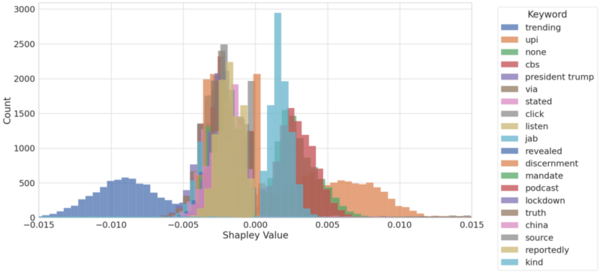
The authors looked at the ability of machine learning algorithms to interpret language given their increasing use in moderating content on social media. Using an explainable model they were able to achieve 81% accuracy in detecting fake vs. real news based on language of posts alone.

Read More...

Racial and gender disparities in the portrayal of lawyers and physicians on television

Asadi et al. | Nov 18, 2022

Racial and gender disparities in the portrayal of lawyers and physicians on television

Powered by the sociological framework that exposure to television bleeds into social biases, limiting media representation of women and minority groups may lead to real-world implications and manifestations of racial and gender disparities. To address this phenomenon, the researchers in this article take a look at primetime fictional representation of minorities and women as lawyers and physicians and compare television representation to census data of the same groups within real-world legal and medical occupations. The authors maintain the hypothesis that representation of female and minority groups as television lawyers and doctors is lower than that of their white male counterparts relative to population demographics - a trend that they expect to also be reflected in actual practice. With fictional racial and gender inequalities and corresponding real-world trends highlighted within this article, the researchers call for address towards representation biases that reinforce each other in both fictional and non-fictional spheres.

Read More...

A model for angle evolution in conical piles formed using the fixed funnel method

Capaldi et al. | Jul 20, 2026

A model for angle evolution in conical piles formed using the fixed funnel method

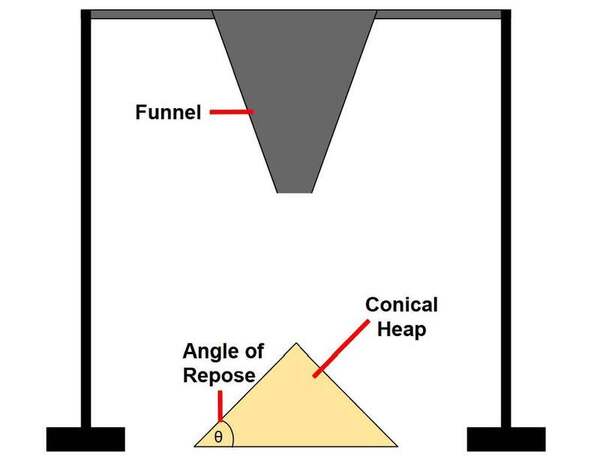
When granular materials are poured onto a surface, they form conical piles whose slopes increase before reaching a stable angle of repose. We found that this angle evolution follows a previously unrecognized two-phase exponential growth pattern that is conserved across granular materials with diverse particle properties. The parameters of this model correlate with particle friction and are influenced by deposition conditions, providing a quantitative framework for describing pile formation.

Read More...